Formula 1

Gymnastics

Formula 1

The pinnacle of motorsport engineering and driver skill.

The Foundations

Friction

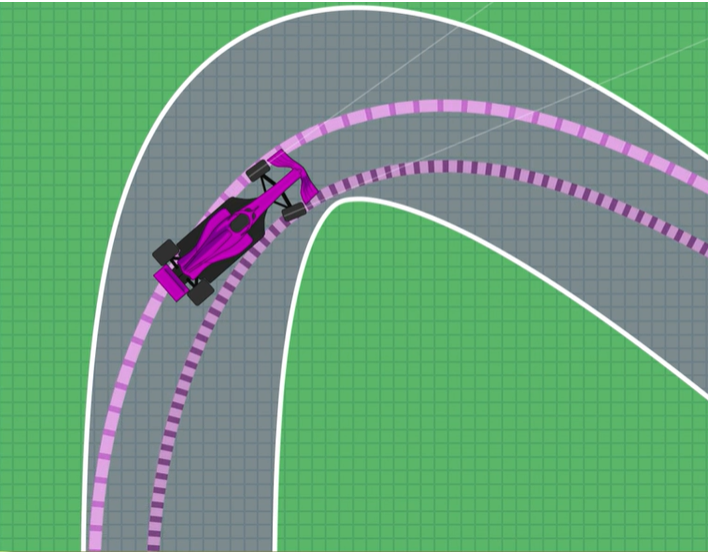
The force that opposes motion between two surfaces. This is what allows tyres to grip the road and allows braking, acceleration, and cornering. However, straight-line friction slows a car down as it is opposing motion rather than being used to change the direction.

The Foundations

Drag

The overall force that opposes motion through a fluid (for F1, this is air). More turbulent (messy) air causes more drag than clean or laminar (uniform) flow of air.
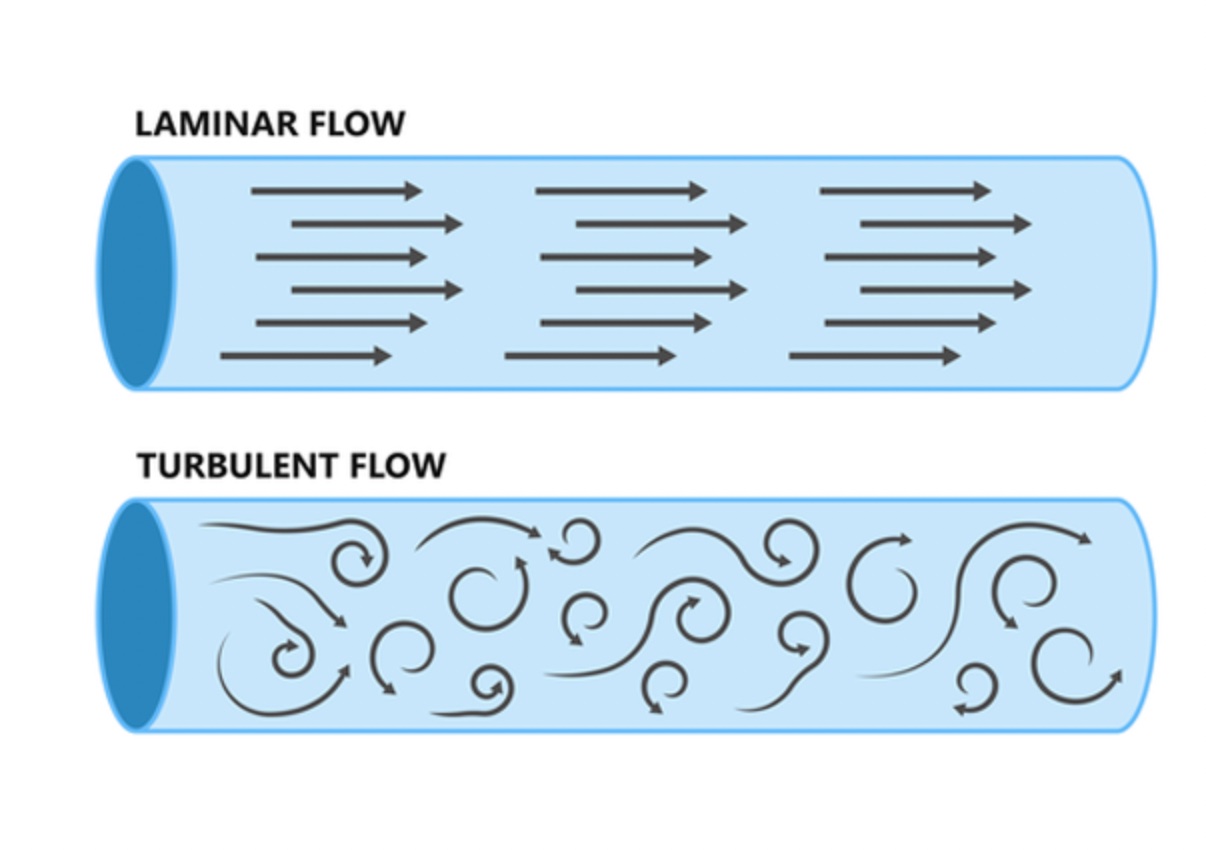
Diagram comparing laminar flow (uniform arrows) vs turbulent flow (chaotic swirls) Image taken from: toptec.pk/air-flow-laminar-or-turbulent
The Foundations

Downforce

The overall force applied downwards on the car due to airflow over and under the car. This is the same concept as lift on a plane but in the opposite direction.

The Foundations

Inertia

The tendency of an object to resist changes in motion. An F1 car travelling straight wants to keep going straight. In cornering, inertia wants the car to continue straight while the tyres must generate forces to change its direction. This is the same as when you turn in a road car too fast — your body leans the opposite way to the direction you are turning.

The Foundations

Momentum

\[ p = m \times v \]Heavier objects or faster objects have a larger momentum (shown by the equation where momentum is the product of mass and velocity), which means a larger force is required to change direction. F1 cars must balance speed (and therefore high momentum) with the ability for the tyres to generate enough force to corner.

The Foundations

Oversteer and Understeer

Understeer: The front tyres lose grip before the rears. The car turns less than the steering input — the front end doesn't have enough friction to overcome the car's inertia and loses grip. Oversteer: The rear tyres lose grip before the fronts. The car turns more than the steering input — the rear slides out. The rear doesn't have enough friction to resist rotation. (Drifting is controlled oversteer.)
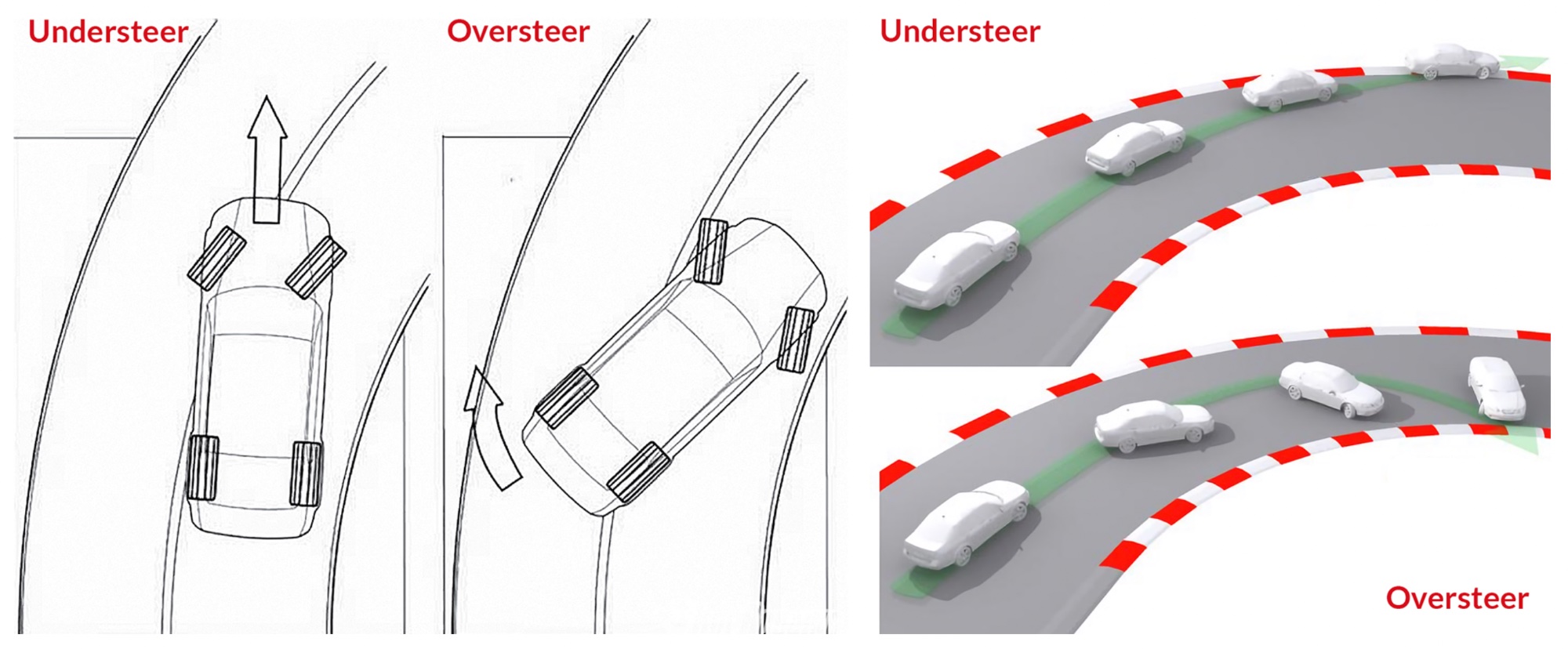
Diagram comparing understeer and oversteer — understeer shows car drifting wide, oversteer shows rear sliding out Image taken from: toc.edu.my — Understeer vs Oversteer
Continue to History

History of Formula 1

Drag or scroll to explore key moments

1950s-1970

GROOVED TYRES ERA

Why grooves mattered when mechanical grip was sufficient for cornering speeds.

Learn more
1958-1961

REAR-ENGINE REVOLUTION

How weight distribution and traction reshaped cornering and stability.

Learn more
1971

SLICK TYRES BECOME STANDARD

Static vs kinetic friction, and how slicks unlocked molecular adhesion.

Learn more
Late 1990s-2000s

ANTI-ACKERMANN STEERING ADOPTED

Slip angle dominance flips classic steering geometry on its head.

Learn more
1998

GROOVED TYRES MANDATED

A safety-driven grip reduction by cutting contact area.

Learn more
2009

SLICKS RETURN

Slicks compensate for reduced aero; grooves remain essential in the wet.

Learn more
The Science of Speed

Aerodynamics in Formula 1

The aerodynamics of Formula 1 can become very complicated very quickly, however the aims of improving aerodynamic performance are very simple. The goal is to control the airflow over the car such that the airflow is as fast and clean (non-turbulent) as possible, making the cars faster in a straight line, and enables the car to produce more downforce.

1950s-1968

The Birth of Aerodynamics in Formula 1

Formula 1 began in 1950, and in its early years no developments were made to improve the cars' aerodynamic performance. In fact, the concept of aerodynamics was still quite foreign to Formula 1 at the time, beyond the basic idea of narrow cars have less drag, due to a smaller cross-sectional area (area made by slicing through a 3-dimensional object).
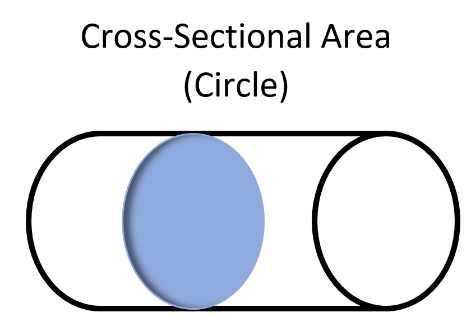
Cross-sectional area diagram showing how slicing through a 3D object creates a 2D cross-section
Cross-sectional area — the area made by slicing through a 3-dimensional object. Image: Energy Education

As a result, the shape of the cars was not thought of to be incredibly crucial, a trend continued until 1968, when one of Formula 1's greatest designers Colin Chapman, added small front wings to his Lotus 49B for the Monaco Grand Prix, and later added various types of wings to the rear of the car.
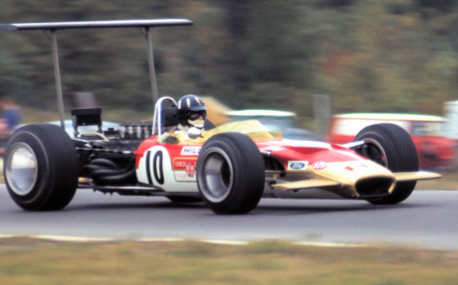
Lotus 49B with its revolutionary front and rear wings
Lotus 49B with its revolutionary wings, causing Lotus to win the constructor's championship and the driver's world title in 1968. Image: DiecastXchange Forum

Newton's 3rd Law in Action

The wings — which were effectively metal panels bolted to the car — utilized Newton's 3rd Law of Motion. The wings direct (force) the air upwards, so the air applies an equal force onto the wings pushing the car into the road (downforce), giving the car more grip and increasing the speed the cars could take around corners.
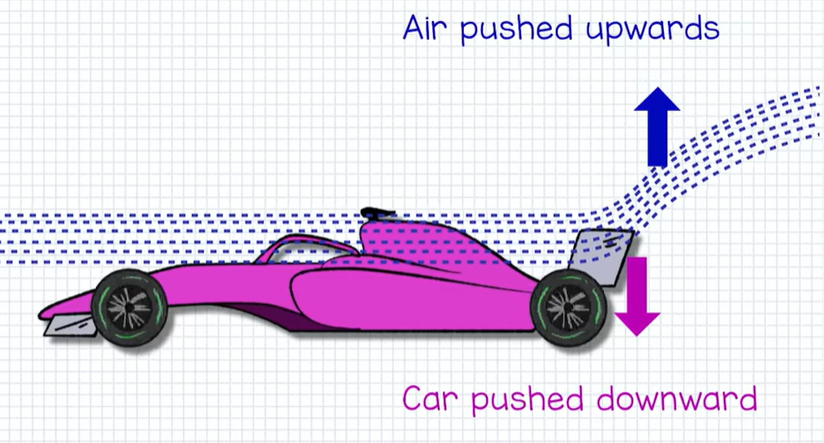
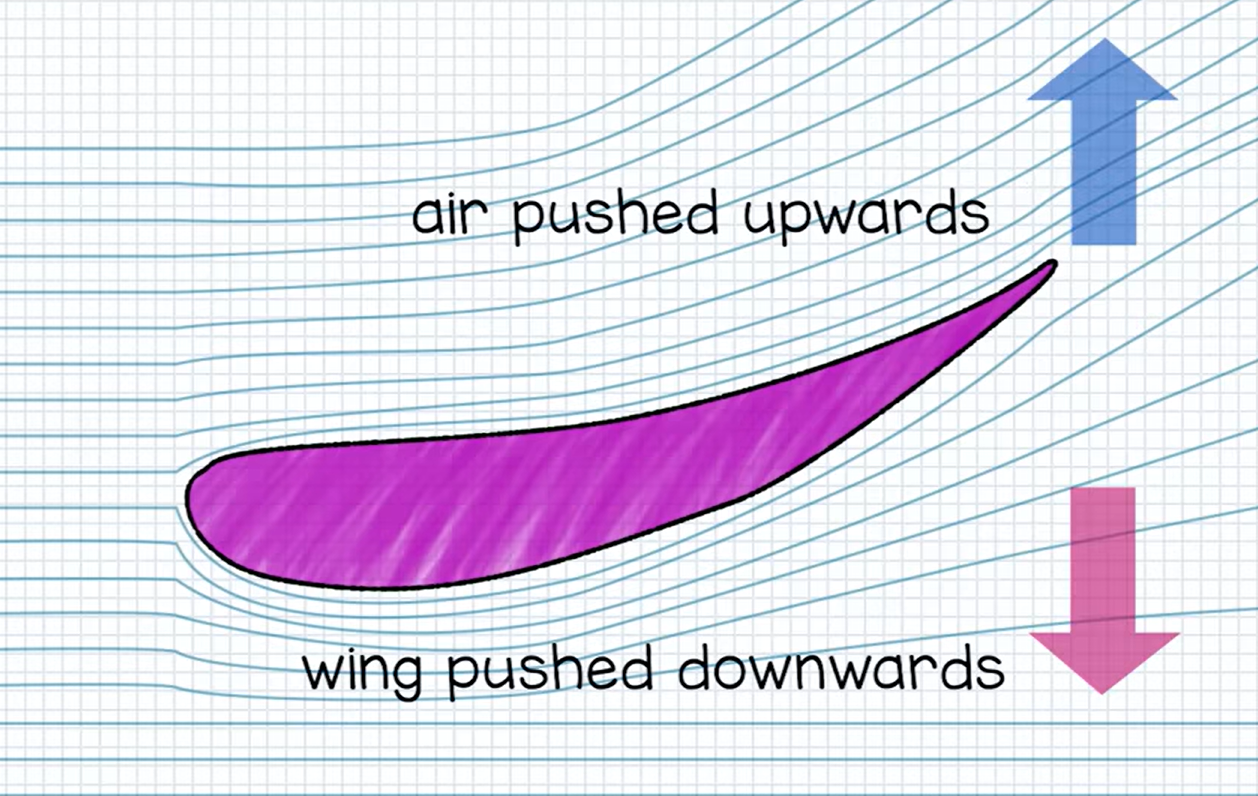
Diagram showing air being directed upwards by the wing
Diagram showing resulting downforce on the car

Diagrams: Chain Bear - F1 Aerodynamics - 1: The Basics

1970s

Cars Change Shape and Ground Effect

F1 cars changed significantly during this decade, they developed a 'boxy' shape with sidepods between the wheels, the wings grew larger and wider and were integrated into the cars' bodywork rather than bolted down.

These changes allowed the cars to generate more downforce, as the wings were able to manipulate the flow of more air molecules than previous designs, as the surface area of the wings was greater.

The Bernoulli Principle

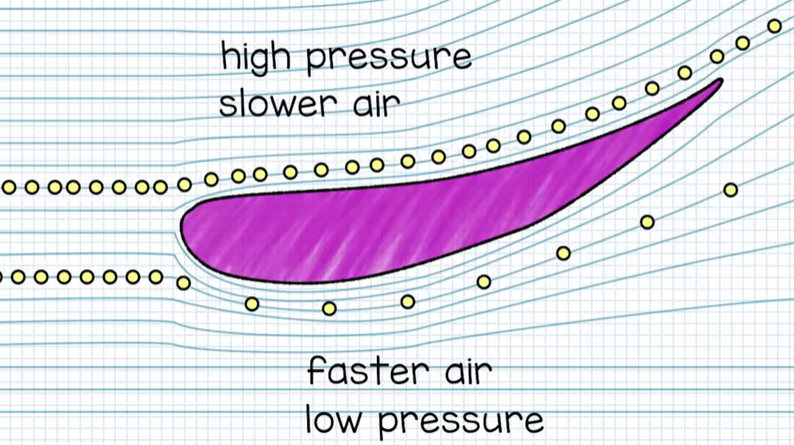
The most significant change to the cars came from Colin Chapman and his Lotus 79, using something called ground effect. Chapman utilized the Bernoulli principle: air containing faster moving air molecules has a lower air pressure, and air molecules travelling through shapes/tubes with a smaller cross-sectional area move at greater speeds.
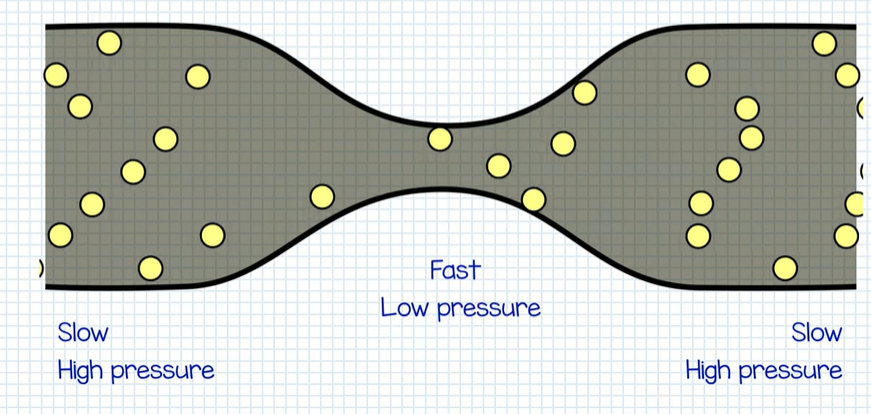
Diagram showing the Bernoulli principle with faster air creating lower pressure
The Bernoulli principle: faster-moving air creates lower pressure. Image: Chain Bear - How F1's 2021 ground effect differs from its fearsome predecessor

By making tunnels under his F1 cars, and using collapsible skirts to seal the air under the car, Chapman's cars had lower pressure air below the car than above the car — effectively sucking the car down onto the road.
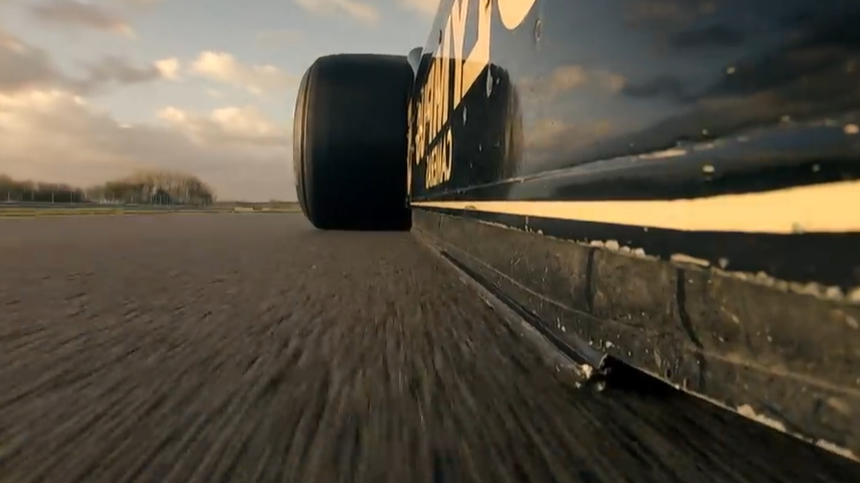
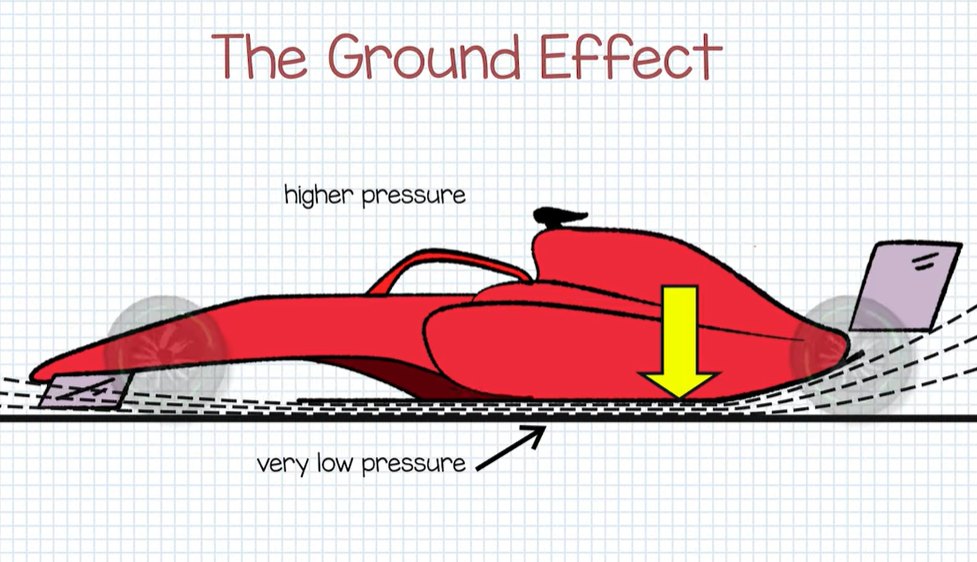
Lotus 79 showing the ground effect skirts
Diagram showing how ground effect creates downforce

Lotus 79 — the dull grey skirts shown above prevented air escaping underneath the sides of the car, sealing the air underneath the car, generating downforce through ground effect. Images: Top Gear: Chris Harris vs the Lotus 79 | Chain Bear - F1 Aerodynamics - 3

Safety Concerns

Collapsible skirts were banned for the 1983 season, due to several high-speed accidents that caused the death of Gilles Villeneuve and ended the racing career of Didier Pironi, though F1 teams continued to maximise ground effect, as it was extremely effective.

1980s-1990s

Evolving Shapes and Diffusers

In response to the loss of collapsible skirts for 1983, diffusers were added to the rear of the cars and worked similarly to tunnels by directing the air flow beneath the car, albeit less effectively than the skirts, as diffusers only worked on the rear of the cars rather than the whole car.

The diffuser is shaped so that air leaving the underside of the car maintains its speed keeping it at a low pressure, thus sucking the car down onto the road.
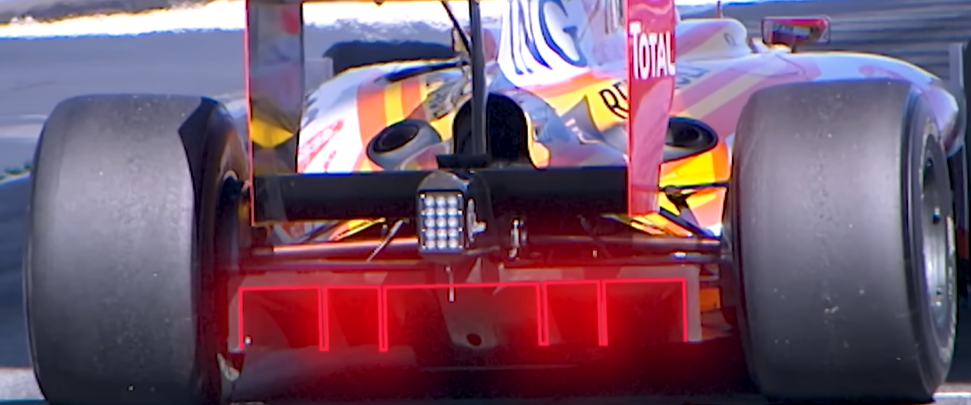
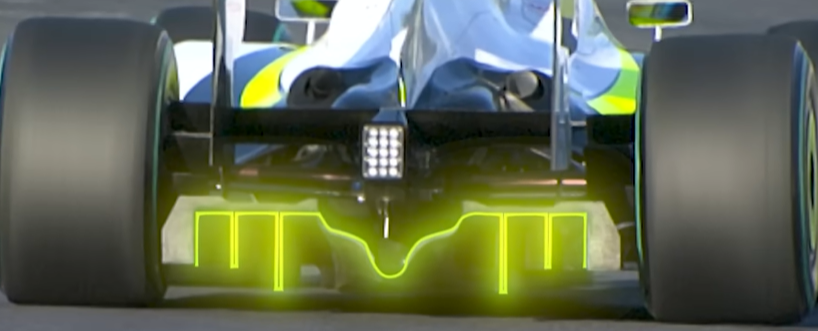
Typical diffuser shape on Renault R29
Unique double diffuser used by Brawn GP on their BGP001
Unique "Double diffuser" used by Brawn GP on their BGP001

The Brawn GP Advantage

The double diffuser design was so effective, the team went on to dominate the 2009 F1 season, and eventually win both the constructor's and driver's world championships.

Reference: Top 10 Cheeky F1 Innovations

Throughout the 80s and into the 90s the cars changed shape from being 'boxy' to 'dart' like and eventually resembling modern cars with a 'coke bottle' shape. By making the cars tighter at the rear, the air speed over the car was maximised, meaning lower pressure air flowed beneath the rear wing and higher pressure above it allowing wings to produce even more downforce, as well as reducing the overall drag acting on a car.
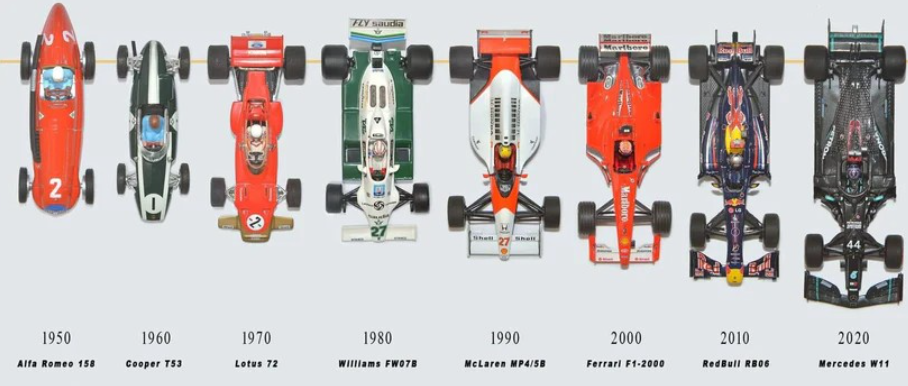
Bird's eye view of F1 cars through time showing the evolution from cigar to box to coke bottle shape
Bird's eye view of the cars through time — modern cars widening in the middle and being tight and narrow towards the rear to create the 'coke bottle' shape. Contrary to the earlier cars that were cigar or box shaped. Image: F1 Mavericks - The Evolution of F1 Car Design Over the Decades
2D diagram demonstrating the difference in pressure above and below the rear wing
2D diagram demonstrating the difference in pressure above and below the rear wing. Image: Chain Bear - F1 Aerodynamics - 1: The Basics
2000s-Present

Entering the Modern Era

As time went on the cars became more curved, as this allowed for cleaner, faster and more efficient air flow, than more angular shapes. However, few significant changes happened specifically related to aerodynamics to improve overall performance, rather the cars gradually changed overtime and improved gradually in terms of aerodynamics, with the optimal shape of the car becoming more influenced by the regulations than the imagination of an engineer.
Key Aerodynamic Principles

Clean Airflow

Minimise turbulence for maximum efficiency

Downforce Generation

Utilise wings and ground effect for grip

Drag Reduction

Coke bottle shapes minimise air resistance

Pressure Differentials

Bernoulli principle creates grip and lift
Performance, Visualised

Loading model…
3d Model Taken From: sketchfab.com

Gymnastics

The human body's incredible capabilities through discipline, dedication, and physics.

The Floor Event

Dynamic Performance

The dynamic floor event in gymnastics combines dance, acrobatic and athleticism, packed into a routine lasting no longer than a minute and a half. On the sprung floor gymnasts perform a series of tumbling passes in succession.

The Floor Event

Tumbling Passes

A tumbling pass refers to a continuous series of flips and somersaults. From the gymnasts' take off to their landing, the principles of energy transfer and conservation form the foundation of the floor event.

The Floor Event

Efficient Technique

Proper technique ensures all the kinetic energy generated during run up and take off is being converted as efficiently as possible. Every movement is calculated to maximise power transfer.

Equipment Physics

The Sprung Floor

The physics of gymnastics does not stem solely from the gymnasts themselves. All of the equipment within a gym is designed with efficiency at its core.

Equipment Physics

Elastic Energy Return

Sprung floors store elastic potential energy when compressed by the gymnast during take-off, which is then transferred back to the gymnast. This energy return increases rebound height whilst reducing the muscular effort required.

Equipment Physics

Minimising Strain

This allows for more complex skills to be executed with minimal body strain, enabling gymnasts to perform multiple high-difficulty passes while protecting their joints and muscles.

Continue to 3D Viewer

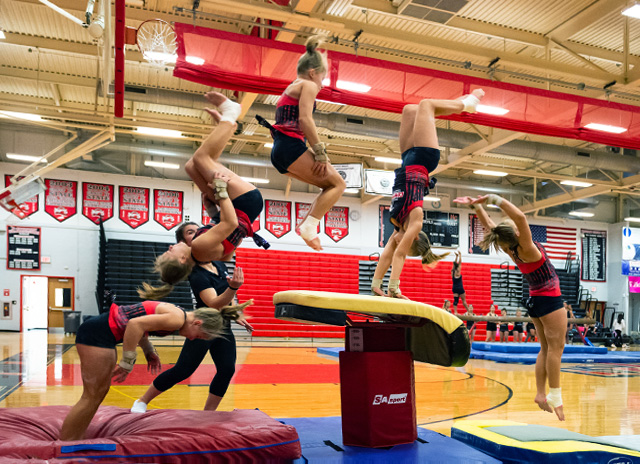
Once a gymnast is airborne there are almost no external torques acting on them, meaning their angular momentum is conserved.

As a result, gymnasts are able to control how fast they rotate by changing their body position midair.

Moving into a tuck or pike position reduces the gymnast's moment of inertia, increasing their angular velocity.

Moment of inertia underpins all of gymnastics as it allows gymnasts to spin faster without any additional force.

The physics involved in safe landings is indisputable. Gymnasts land with their knees bent and attempt to "stick" their landing.

By bending their knees they increase the time in which their momentum is brought to zero, reducing the force acting on them.

This same concept is used in crumple zones in cars. The crash mats allow momentum to dissipate over a longer period, protecting joints and reducing impact forces.

Progress 0%
Scroll to explore
Scroll to play animation
3d Model Taken From: sketchfab.com

The Vault

The vault in gymnastics is a high-speed, explosive event in which performance is driven by principles such as momentum, energy transfer, and rotational mechanics. The horizontal momentum generated during the run-up is converted to vertical lift and angular rotation before landing. Elite gymnasts increase the difficulty by adding somersaults or twists, which require precise control of their body position. Although deductions are often most visible at the landing stage, successful execution depends on every phase, from the run-up to the landing. The scoring system reflects both the difficulty and execution of the vault.

Click on each stage to explore the physics

Vault sequence showing 5 stages
10%
20%
30%
40%
50%
60%
70%
80%
90%
10%
20%
30%
40%
50%
60%
70%
80%
90%
1
2
3
4

1. Takeoff from the springboard

On contact with the springboard, some of the gymnast's kinetic energy is transferred to the elastic potential energy stored in the springboard. The 'punch' is the gymnast's contact with the springboard, and a greater force applied to the springboard increases the energy transferred. The remainder of the vault depends on maximising the vertical component of force at take-off, so the gymnast gains sufficient height to complete the move safely before landing. The gymnast must generate enough vertical force to produce a vertical velocity that can counteract gravity. The speed and maximum height of the centre of mass will determine the gymnast's post-flight trajectory.

2. Contact phase ('punch')

The contact phase of the vault must be quick and powerful to generate sufficient upward force. This contributes to the torque required for rotation in the next phase. The gymnast will 'block' when their hands touch the vault table, keeping the arms stiff and straight, which increases the component of vertical velocity of the gymnast.

3. Post-flight phase

This phase of the vault depends on the earlier phases being executed correctly and efficiently. The complexity and execution of this phase are crucial for the overall score. The only forces acting on the gymnast while airborne are gravity and air resistance, which are typically negligible in an indoor competition gymnasium.

The gymnast's translational velocity is approximately constant while airborne, indicating that no significant horizontal force acts on the gymnast. Torque is generated by the movement of the gymnast's legs over the head. Angular velocity increases when the gymnast shortens their body, for example, in a tuck position, which is why lay out vaults are considered more difficult.

Angular momentum remains constant during the post-flight phase because there is no significant external torque acting on the gymnast until landing. As angular momentum is conserved in a tuck position, the moment of inertia decreases. If the earlier phases have been performed correctly, the gymnast should be as high and far from the vault table as possible, to achieve a landing angle as close to 90 degrees with the floor as possible.

4. The landing

Gymnasts must absorb the impact and maintain balance to achieve a controlled, stable landing. Most deductions occur at the landing, but performance here depends largely on the earlier phases being performed well. Gymnasts aim to land at approximately 90 degrees to the ground, so that the ground reaction force acts vertically upward, so that the gymnast will not be pushed forward or backwards, causing deductions. Therefore, the gymnast aims to be fully extended at the point of initial ground contact. This can be illustrated by the fact that if you land on a trampoline with your feet in front of your centre of mass, you are thrown backwards! Gymnasts bend their legs to increase the time over which their momentum is reduced to zero, which decreases the landing force on their legs, in accordance with Newton's second law.


Image taken from: topendsports.com

Underlined terms are interactive — hover or tap for physics definitions & equations

The Bars

The uneven bars event in gymnastics combines continuous motion, strength and meticulous timing. Routines include full rotations known as giants, transitional moves between the low and high bar, and finish with release moves and dismounts. The physics of the uneven bars is grounded almost entirely in rotational motion and energy transfer.

Energy Conversion

As the gymnast swings around the entire bar, their gravitational potential energy is converted into kinetic energy. This speed and the resulting momentum allow the gymnast to link skills smoothly and to remain in continuous motion.

Centripetal Force

To stay on a circular path around the bar, a centripetal force is required as the gymnast rotates around their centre of mass. This force is provided by the tension in the gymnast's body, primarily their arms and shoulders, as they pull on the bar. This centripetal force increases with speed, meaning that the force experienced by the gymnast is the largest at the bottom of the swing, where the gymnast's velocity is the highest.

Angular Momentum

During giants and release moves, gymnasts generate angular momentum through torque applied at the shoulders and hips. Their resulting angular momentum is determined by both their moment of inertia and their angular velocity. Once they let go of the bar during a release move, their angular momentum is conserved as there is negligible external torque on the gymnast. By changing their body shape, the gymnast must transfer angular momentum between different parts of their body, while preventing over-rotation. This transfer between body parts decreases the gymnast's angular velocity, enabling a successful landing.

Pendulum Motion

When a gymnast swings around the bars with their body held straight, their motion can be modelled as a pendulum. As they rotate, the swing of the gymnast is affected by the friction between the gymnast's hands and the bar, air resistance and the torque produced by gravity acting on their body. Both friction and air resistance continuously oppose the rotation of the gymnast, while torque can either promote rotation on the downswing or counteract rotation on the upswing. Since energy is lost to these resistive forces, a gymnast must adjust their body positioning to reduce their moment of inertia on the upswing; this ensures that they maintain a high enough angular velocity to complete the rotation or perform a controlled dismount.

Did you know?

The Role of Chalk

One key feature of the uneven bars is the use of chalk on the hands before performing. Chalk increases the coefficient of friction between the gymnast's hands and the bar, allowing a more secure grip. It works by absorbing moisture, such as sweat, which restores dry surface contact and prevents slipping. At the same time, chalk helps regulate friction by making it more uniform and predictable. This allows the hands to rotate smoothly around the bar during swings and giants. If chalk is not used, friction can cause the skin to stick unevenly to the bars, leading to chaffing or even blisters.